
Compendium
At a glance
Card essence
The Five of Swords shows conflict, the cost of victory, and the need to lay down a fight that destroys trust.
The Five of Swords speaks of dispute, advantage, and bitter victory. It asks whether the need to be right costs more than the matter itself.
- Main lesson
- Not every win is a success; sometimes the greatest strength is laying down the sword at the right moment.
- Main axis
- being right — preserving relationship
- Core tension
- Is it more important to win the argument, or to preserve dignity, trust, and the possibility of further dialogue?
Am I trying to solve the matter, or only win the conflict?
Essential
Meaning and interpretation
Card meaning
General
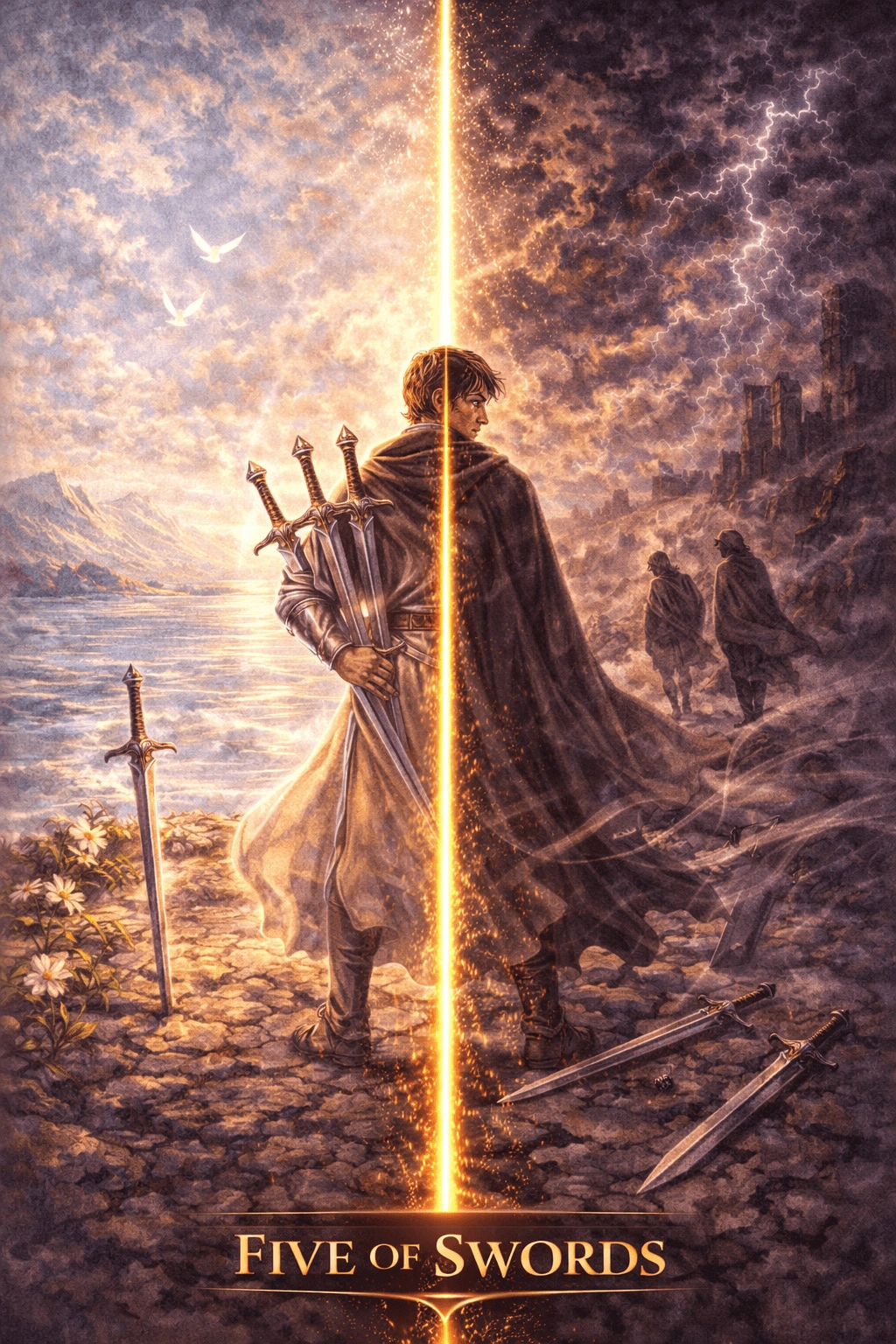
The Five of Swords is one of the cards that refuses to romanticize conflict. It shows the moment after a clash: someone holds the swords, someone walks away, and the atmosphere is cold and not fully cleared. It can be read as dispute, rivalry, tactics, verbal advantage, manipulation of arguments, or a situation where winning stops being a real success.
Its core is the tension between intellect and connection. Swords want to name, decide, and cut through, but the five introduces destabilization. The card therefore asks whether defending your position is destroying something more important: respect, trust, inner peace, or the possibility of understanding.
It does not always mean defeat. Sometimes it shows the need to step out of a game in which everyone loses, or to face reality: someone is not playing fair, the conversation has become a battlefield, and further persuasion only deepens the split.
General
This card often speaks of tension after a dispute, cool strategy, a win paid for with lost trust, or words that cannot easily be taken back. The point is not only who is right, but what remains after the confrontation.
In practical interpretation, the Five of Swords asks you to check whether the fight still makes sense or has become an automatic defense of the ego.
General
The Five of Swords shows conflict in which victory itself does not bring peace. It asks how much the need to prove your point is really costing.
Full synthesis and expanded meaning
Expanded meaning
This card points to tension after conflict, sharp words, and a game of advantage. It can mean a win that brings no peace, or a situation in which someone walks away with a sense of loss. Reversed, it often shows fatigue with fighting, an attempt at reconciliation, or quiet resentment that needs to be named.
Five of Swords — conflict, bitter victory, and the price of being right
The Five of Swords in the Rider–Waite–Smith system shows the moment after a clash: one figure holds swords, others walk away, and the sky remains unsettled. This is not an image of clean triumph, but a question about the price of victory. Upright, the card can indicate dispute, sharp communication, strategy, advantage, manipulation of arguments, or the need for the last word. Reversed, it often speaks of fatigue with conflict, an attempt at reconciliation, withdrawal from the fight, or quiet resentment that still needs to be named.
Psychologically, the card touches a defense mechanism: I attack before I show that I am hurt. Its shadow is domination, coldness, pride, and the inability to let go. In relationships it shows fighting to be right instead of dialogue. At work it warns against politics, public point-scoring, and the reputational cost of winning. In finances it encourages transparent agreements, checking documents, and avoiding decisions made from pressure or revenge. Spiritually, it asks whether truth is connected with compassion. In body and energy, it can be read symbolically as tension after dispute, vigilance, and the need to come down from fight mode.
Numerologically, five brings crisis, friction, and destabilization; in the suit of Swords, this concerns thinking, words, and decisions. In Hermetic traditions the card is often linked with the theme of defeat and the attribution Venus in Aquarius, but it should not be reduced only to failure. Important combinations with other cards reveal different shades of conflict: with Justice it speaks of consequences, with the Tower of sudden rupture, with the Devil of a toxic game, with Temperance of the need for mediation, and with the Seven of Swords of strategy and hidden action. The most common mistake is reading this card as simple victory or simple evil. Its real lesson is sharper and more practical: choose whether you want to be right or whether you want to leave the situation with your humanity intact.
Synthesis
The Five of Swords is a card of conflict in which victory itself is not enough. It shows dispute, cool strategy, verbal advantage, and also the cost: lost trust, distance, loneliness, or the feeling that someone was humiliated. Upright, it can point to rivalry, manipulation of arguments, the need for the last word, or the need to leave an unfair game. Reversed, it speaks of de-escalating conflict, repair attempts, apologies, or conflict hidden below the surface. The card’s central lesson is clear: boundaries are necessary, but they do not have to wound. In relationships it asks for leaving the winner-loser pattern, at work for professional tone and facts, in finances for transparent terms, and spiritually for truth joined with humility.
Life areasLove, work, health, and other contexts
No additional content is available for the selected orientation.
Card in a spreadSpread → position → meaning
General
The situation opens with a conflict of interests, communication tension, or the feeling that someone must win in order not to lose control. Check immediately whether the conversation still seeks resolution.
Working with the cardAdvice, shadow, potential, and possible outcome
Set the boundary clearly, but do not use truth as a weapon.
Symbolism and deeper knowledgeSymbols, archetypes, numerology, and traditions
Symbolism
figure holding swords
General meaning
An image of advantage after conflict that does not look like complete triumph.
Psychology
It can show defensive control and the need to prove one is right.
Spirituality
It reminds us that truth without humility can become a tool of separation.
Practical reading
Check whether the current strategy solves the problem or only gives temporary advantage.
Shadow
Risk of domination, humiliation, and loneliness after winning.
figures walking away
General meaning
They show those who withdraw after a dispute or carry the cost of confrontation.
Psychology
They may symbolize parts of the psyche that leave contact after being hurt.
Spirituality
They point to the lesson of compassion toward the defeated sides of conflict.
Practical reading
Notice who becomes silent, walks away, or loses their voice in the situation.
Shadow
Ignoring the effect your words have on others.
abandoned swords
General meaning
They signify loss, disarmament, or the consequences of battle.
Psychology
They may speak of arguments that no longer serve truth.
Spirituality
They suggest the practice of putting down what now only wounds.
Practical reading
Not every tool has to be carried forward; part of the dispute can be left behind.
Shadow
Clinging to an old narrative only because it was useful in battle.
clouded sky
General meaning
The atmosphere remains tense even though the clash is already over.
Psychology
It shows mental overload, distrust, and inner noise after conflict.
Spirituality
It reminds us that cleansing takes time, not just a verdict.
Practical reading
Do not assume that the absence of argument means peace.
Shadow
A seeming ending under which resentment still operates.
water in the background
General meaning
Emotions are present but pushed behind cool logic.
Psychology
It may point to hurt hidden under rationalization.
Spirituality
It links the blade of the mind with the need to return to the heart.
Practical reading
Ask what feeling stands beneath the argument.
Shadow
Using logic to bypass pain.
uneven scene after battle
General meaning
The situation is unstable and needs to be faced realistically.
Psychology
It shows lack of inner balance after a defensive reaction.
Spirituality
It reminds us that peace does not automatically return after victory.
Practical reading
Identify what was actually damaged by the conflict.
Shadow
Pretending that because someone won, everything is fine.
number five
General meaning
It brings crisis, friction, and the need to change the way one acts.
Psychology
It shows the moment when an old defense mechanism stops working.
Spirituality
It can be a test of humility after destabilization.
Practical reading
A crisis requires correction, not merely stronger pressure.
Shadow
Escalating conflict in order to avoid change.
suit of swords
General meaning
Swords relate to mind, communication, decisions, and conflict.
Psychology
The blade symbolizes thought that can distinguish or wound.
Spirituality
It encourages purification of the intention behind words.
Practical reading
Listen to the tone of the conversation as carefully as to its content.
Shadow
A cutting tongue used as proof of strength.
Archetype
Psychology
On the psychological level, the Five of Swords shows the state after defensive activation. The mind moves quickly, searches for weak points, builds arguments, and tries to regain control. This mechanism can be useful when manipulation must be seen clearly or a boundary must be set, but it easily becomes excessive: every conversation starts to look like a duel.
Archetypally, the card combines several figures: the strategist who won but no longer knows how to trust; the exile leaving the field of conflict; the witness who sees the cost of the dispute; and the inner judge demanding a culprit.
Integration of this card means recovering the ability to choose. Not every criticism requires a counterattack, not every loss takes away your worth, and not every silence is weakness. The Five of Swords teaches the difference between a clear boundary and a fight that merely reenacts an old wound.
Psychology
The card can be read through the motifs of the joyless victor, the person excluded from the conversation, the cool negotiator, and the inner critic. In the psyche it often connects with a defense mechanism: better to attack than to show vulnerability.
The Five of Swords may suggest the need to recognize when rationalization, irony, or a cutting tongue are being used to protect against pain, shame, or a feeling of defeat.
Psychology
Psychologically, the Five of Swords touches the archetype of the strategist after conflict and the person wounded by their own defenses. It shows the tension between self-protection and the destruction of contact.
Numerology
General
The number five is movement after the stability of four. Where the Four of Swords needed rest and withdrawal, the Five of Swords brings disturbance, clash, and the need to change the way the mind uses its blade.
In the suit of Swords, the five tests thinking, language, judgment, and the habit of cutting through matters too sharply. The card shows that intellect alone does not guarantee wisdom. A clear argument can become cruel; a good strategy can become manipulation; a justified boundary can become a habit of war.
The numerological lesson is correction under pressure. Something in the mental order no longer holds. The question is whether the crisis will become greater honesty and maturity, or merely a stronger attachment to the need to be right.
General
Fives in tarot often show tension, loss of balance, and a moment when the previous arrangement stops working. In the suit of Swords this concerns thinking, communication, decisions, and verbal conflict.
Numerologically, the Five of Swords speaks of a crisis of perspective: it is necessary to see whether the fight truly leads to resolution or only deepens division.
General
The number five brings crisis, movement, and disruption of order into the suit of Swords. In this card, intellect becomes a field of trial.
Archetypes
- the joyless victor
- the strategist after conflict
- the wounded defender
- the witness to a split
- the person leaving the battlefield
Traditions and attributions
Rider–Waite–Smith
conflict, bitter victory, the cost of advantage, and tension after a dispute
Confidence: high
The RWS meaning is based on the scene after a confrontation: one figure gathers swords while others walk away.
Marseille Tarot
the five in the suit of swords as a crisis of mental order and friction in communication
Confidence: medium
In the Marseille deck, interpretation more often comes from number, suit, and pip arrangement than from a narrative scene.
Golden Dawn
Venus in Aquarius; traditionally associated with defeat or a defect in harmony
Confidence: medium
The Hermetic attribution is influential in schools derived from the Golden Dawn, but it is not universal across all tarot.
Thoth/Crowley
Defeat; mental tension, breakdown of harmony, and dissonance in the field of ideas
Confidence: medium
In the Thoth deck the card strongly emphasizes defeat and disturbed coherence, which is worth comparing with the more narrative RWS scene.
Connections and learningCombinations, similar cards, mistakes, and reflection
King of Swords
Court
General meaning
With King of Swords, the card points to a person or communication style that uses the sword of intellect with particular force.
Psychology
Psychologically, it asks how maturity, pride, and mental control shape the interaction.
Relationships
In relationships, it asks whether the dynamic leads to repair or keeps both sides in a winner-loser script.
Career and finances
In work and finances, it favors clear facts, documented terms, and avoiding decisions driven by pressure or revenge.
Shadow and warning
Do not let the wish to win override dignity, proportion, and long-term trust.
Knight of Swords
Court
General meaning
With Knight of Swords, the card points to a person or communication style that uses the sword of intellect with particular force.
Psychology
Psychologically, it asks how maturity, pride, and mental control shape the interaction.
Relationships
In relationships, it asks whether the dynamic leads to repair or keeps both sides in a winner-loser script.
Career and finances
In work and finances, it favors clear facts, documented terms, and avoiding decisions driven by pressure or revenge.
Shadow and warning
Do not let the wish to win override dignity, proportion, and long-term trust.
Page of Swords
Court
General meaning
With Page of Swords, the card points to a person or communication style that uses the sword of intellect with particular force.
Psychology
Psychologically, it asks how maturity, pride, and mental control shape the interaction.
Relationships
In relationships, it asks whether the dynamic leads to repair or keeps both sides in a winner-loser script.
Career and finances
In work and finances, it favors clear facts, documented terms, and avoiding decisions driven by pressure or revenge.
Shadow and warning
Do not let the wish to win override dignity, proportion, and long-term trust.
Queen of Swords
Court
General meaning
With Queen of Swords, the card points to a person or communication style that uses the sword of intellect with particular force.
Psychology
Psychologically, it asks how maturity, pride, and mental control shape the interaction.
Relationships
In relationships, it asks whether the dynamic leads to repair or keeps both sides in a winner-loser script.
Career and finances
In work and finances, it favors clear facts, documented terms, and avoiding decisions driven by pressure or revenge.
Shadow and warning
Do not let the wish to win override dignity, proportion, and long-term trust.
Two of Cups
Cups
General meaning
With Two of Cups, the conflict of words exposes emotional loss, longing, or the need to step away from pain.
Psychology
Psychologically, the combination highlights defense patterns, pride, and the need to see what is really being protected.
Relationships
In relationships, hurt feelings must be named instead of hidden behind pride.
Career and finances
In work and finances, it favors clear facts, documented terms, and avoiding decisions driven by pressure or revenge.
Shadow and warning
Do not let the wish to win override dignity, proportion, and long-term trust.
Five of Cups
Cups
General meaning
With Five of Cups, the conflict of words exposes emotional loss, longing, or the need to step away from pain.
Psychology
Psychologically, the combination highlights defense patterns, pride, and the need to see what is really being protected.
Relationships
In relationships, hurt feelings must be named instead of hidden behind pride.
Career and finances
In work and finances, it favors clear facts, documented terms, and avoiding decisions driven by pressure or revenge.
Shadow and warning
Do not let the wish to win override dignity, proportion, and long-term trust.
Seven of Cups
Cups
General meaning
With Seven of Cups, the conflict of words exposes emotional loss, longing, or the need to step away from pain.
Psychology
Psychologically, the combination highlights defense patterns, pride, and the need to see what is really being protected.
Relationships
In relationships, hurt feelings must be named instead of hidden behind pride.
Career and finances
In work and finances, it favors clear facts, documented terms, and avoiding decisions driven by pressure or revenge.
Shadow and warning
Do not let the wish to win override dignity, proportion, and long-term trust.
Eight of Cups
Cups
General meaning
With Eight of Cups, the conflict of words exposes emotional loss, longing, or the need to step away from pain.
Psychology
Psychologically, the combination highlights defense patterns, pride, and the need to see what is really being protected.
Relationships
In relationships, hurt feelings must be named instead of hidden behind pride.
Career and finances
In work and finances, it favors clear facts, documented terms, and avoiding decisions driven by pressure or revenge.
Shadow and warning
Do not let the wish to win override dignity, proportion, and long-term trust.
Queen of Cups
Cups
General meaning
With Queen of Cups, the conflict of words exposes emotional loss, longing, or the need to step away from pain.
Psychology
Psychologically, the combination highlights defense patterns, pride, and the need to see what is really being protected.
Relationships
In relationships, hurt feelings must be named instead of hidden behind pride.
Career and finances
In work and finances, it favors clear facts, documented terms, and avoiding decisions driven by pressure or revenge.
Shadow and warning
Do not let the wish to win override dignity, proportion, and long-term trust.
The Lovers VI
Major
General meaning
A choice of the heart is confronted by conflict of the mind.
Psychology
There is tension between the need for closeness and the need to win.
Relationships
The relationship must choose: understanding or continued battle.
Career and finances
Cooperation needs shared values, not only strategy.
Shadow and warning
Do not confuse choice with trying to subordinate the other person.
The Chariot VII
Major
General meaning
Strong will can win, but it must control the direction of conflict.
Psychology
Ambition meets the defense mechanism.
Relationships
Someone may force their pace and narrative in the relationship.
Career and finances
At work, this combination supports strategic movement if the tone stays professional.
Shadow and warning
Beware domination and driving toward victory at any cost.
The Hermit IX
Major
General meaning
After conflict, distance and quiet discernment are needed.
Psychology
Withdrawal helps separate truth from wounded pride.
Relationships
The relationship may need silence before returning to dialogue.
Career and finances
At work, analyze facts rather than respond immediately.
Shadow and warning
Do not escape into solitude just to avoid responsibility.
Justice XI
Major
General meaning
Conflict meets the need for objective judgment.
Psychology
The mind wants to be right, but must acknowledge consequences.
Relationships
The relationship needs fair rules, not a game of advantage.
Career and finances
Good for documents, responsibility, and formal agreements.
Shadow and warning
Do not use law or morality as a tool of revenge.
Temperance XIV
Major
General meaning
Conflict needs softening, proportion, and patient alchemy.
Psychology
It teaches regulation of tension instead of instant reaction.
Relationships
In relationships, it favors calm mediation after sharp words.
Career and finances
Good for negotiation, adjusting terms, and rebuilding cooperation.
Shadow and warning
Do not pretend harmony if the problem is still active.
The Devil XV
Major
General meaning
The game of advantage may have a toxic, dependent character.
Psychology
The shadow concerns control, compulsion, and attachment to fighting.
Relationships
A relationship may rely on manipulation, jealousy, or punishment.
Career and finances
Beware of arrangements where one side profits from the dependence of another.
Shadow and warning
Do not rationalize behavior that takes freedom away.
The Tower XVI
Major
General meaning
A dispute may lead to a sudden break in the structure.
Psychology
Accumulated defense can no longer hold the old construction together.
Relationships
An argument may reveal something that can no longer be hidden.
Career and finances
A crisis at work or in finances may arise from pressure and conflict.
Shadow and warning
Do not burn everything down just to have the last word.
The Moon XVIII
Major
General meaning
Conflict mixes with fear, assumptions, and unclear narrative.
Psychology
The mind may be fighting projections rather than facts.
Relationships
Suspicion, silence, and emotional fog are possible in the relationship.
Career and finances
In work and finances, separate documents from rumors.
Shadow and warning
Do not attack on uncertain assumptions.
The Sun XIX
Major
General meaning
Clarity can interrupt the game and reveal the real cost of conflict.
Psychology
Awareness illuminates the defense mechanism.
Relationships
The relationship has a chance for honesty if both sides stop humiliating each other.
Career and finances
At work, visible facts limit politics and hidden games.
Shadow and warning
Do not use honesty as an excuse for brutality.
Judgement XX
Major
General meaning
The dispute leads to reckoning, awakening, or a call to responsibility.
Psychology
The psyche sees the effects of old reactions.
Relationships
In a relationship, it can mean a conversation that can no longer be postponed.
Career and finances
At work and in finances, it favors reviewing decisions and consequences.
Shadow and warning
Do not turn accountability into public shaming.
Four of Pentacles
Pentacles
General meaning
With Four of Pentacles, the dispute takes a practical form around resources, security, responsibility, or long-term results.
Psychology
Psychologically, the combination highlights defense patterns, pride, and the need to see what is really being protected.
Relationships
In relationships, it asks whether the dynamic leads to repair or keeps both sides in a winner-loser script.
Career and finances
In finances, clarify terms, obligations, costs, and the real price of continuing the fight.
Shadow and warning
Do not let the wish to win override dignity, proportion, and long-term trust.
Five of Pentacles
Pentacles
General meaning
With Five of Pentacles, the dispute takes a practical form around resources, security, responsibility, or long-term results.
Psychology
Psychologically, the combination highlights defense patterns, pride, and the need to see what is really being protected.
Relationships
In relationships, it asks whether the dynamic leads to repair or keeps both sides in a winner-loser script.
Career and finances
In finances, clarify terms, obligations, costs, and the real price of continuing the fight.
Shadow and warning
Do not let the wish to win override dignity, proportion, and long-term trust.
Six of Pentacles
Pentacles
General meaning
With Six of Pentacles, the dispute takes a practical form around resources, security, responsibility, or long-term results.
Psychology
Psychologically, the combination highlights defense patterns, pride, and the need to see what is really being protected.
Relationships
In relationships, it asks whether the dynamic leads to repair or keeps both sides in a winner-loser script.
Career and finances
In finances, clarify terms, obligations, costs, and the real price of continuing the fight.
Shadow and warning
Do not let the wish to win override dignity, proportion, and long-term trust.
Seven of Pentacles
Pentacles
General meaning
With Seven of Pentacles, the dispute takes a practical form around resources, security, responsibility, or long-term results.
Psychology
Psychologically, the combination highlights defense patterns, pride, and the need to see what is really being protected.
Relationships
In relationships, it asks whether the dynamic leads to repair or keeps both sides in a winner-loser script.
Career and finances
In finances, clarify terms, obligations, costs, and the real price of continuing the fight.
Shadow and warning
Do not let the wish to win override dignity, proportion, and long-term trust.
Ten of Pentacles
Pentacles
General meaning
With Ten of Pentacles, the dispute takes a practical form around resources, security, responsibility, or long-term results.
Psychology
Psychologically, the combination highlights defense patterns, pride, and the need to see what is really being protected.
Relationships
In relationships, it asks whether the dynamic leads to repair or keeps both sides in a winner-loser script.
Career and finances
In finances, clarify terms, obligations, costs, and the real price of continuing the fight.
Shadow and warning
Do not let the wish to win override dignity, proportion, and long-term trust.
Two of Swords
Swords
General meaning
With Two of Swords, the theme of mental tension, strategy, and difficult communication becomes stronger.
Psychology
The mind may double down on defense, analysis, suspicion, or painful conclusions.
Relationships
In relationships, it asks whether the dynamic leads to repair or keeps both sides in a winner-loser script.
Career and finances
In work and finances, it favors clear facts, documented terms, and avoiding decisions driven by pressure or revenge.
Shadow and warning
Do not let the wish to win override dignity, proportion, and long-term trust.
Three of Swords
Swords
General meaning
With Three of Swords, the theme of mental tension, strategy, and difficult communication becomes stronger.
Psychology
The mind may double down on defense, analysis, suspicion, or painful conclusions.
Relationships
In relationships, it asks whether the dynamic leads to repair or keeps both sides in a winner-loser script.
Career and finances
In work and finances, it favors clear facts, documented terms, and avoiding decisions driven by pressure or revenge.
Shadow and warning
Do not let the wish to win override dignity, proportion, and long-term trust.
Seven of Swords
Swords
General meaning
With Seven of Swords, the theme of mental tension, strategy, and difficult communication becomes stronger.
Psychology
The mind may double down on defense, analysis, suspicion, or painful conclusions.
Relationships
In relationships, it asks whether the dynamic leads to repair or keeps both sides in a winner-loser script.
Career and finances
In work and finances, it favors clear facts, documented terms, and avoiding decisions driven by pressure or revenge.
Shadow and warning
Do not let the wish to win override dignity, proportion, and long-term trust.
Nine of Swords
Swords
General meaning
With Nine of Swords, the theme of mental tension, strategy, and difficult communication becomes stronger.
Psychology
The mind may double down on defense, analysis, suspicion, or painful conclusions.
Relationships
In relationships, it asks whether the dynamic leads to repair or keeps both sides in a winner-loser script.
Career and finances
In work and finances, it favors clear facts, documented terms, and avoiding decisions driven by pressure or revenge.
Shadow and warning
Do not let the wish to win override dignity, proportion, and long-term trust.
Ten of Swords
Swords
General meaning
With Ten of Swords, the theme of mental tension, strategy, and difficult communication becomes stronger.
Psychology
The mind may double down on defense, analysis, suspicion, or painful conclusions.
Relationships
In relationships, it asks whether the dynamic leads to repair or keeps both sides in a winner-loser script.
Career and finances
In work and finances, it favors clear facts, documented terms, and avoiding decisions driven by pressure or revenge.
Shadow and warning
Do not let the wish to win override dignity, proportion, and long-term trust.
Five of Wands
Wands
General meaning
With Five of Wands, mental conflict combines with ambition, competition, and the urge to act quickly.
Psychology
Psychologically, the combination highlights defense patterns, pride, and the need to see what is really being protected.
Relationships
In relationships, it asks whether the dynamic leads to repair or keeps both sides in a winner-loser script.
Career and finances
At work, competition needs rules or it turns into personal rivalry.
Shadow and warning
Do not let the wish to win override dignity, proportion, and long-term trust.
Seven of Wands
Wands
General meaning
With Seven of Wands, mental conflict combines with ambition, competition, and the urge to act quickly.
Psychology
Psychologically, the combination highlights defense patterns, pride, and the need to see what is really being protected.
Relationships
In relationships, it asks whether the dynamic leads to repair or keeps both sides in a winner-loser script.
Career and finances
At work, competition needs rules or it turns into personal rivalry.
Shadow and warning
Do not let the wish to win override dignity, proportion, and long-term trust.
Eight of Wands
Wands
General meaning
With Eight of Wands, mental conflict combines with ambition, competition, and the urge to act quickly.
Psychology
Psychologically, the combination highlights defense patterns, pride, and the need to see what is really being protected.
Relationships
In relationships, it asks whether the dynamic leads to repair or keeps both sides in a winner-loser script.
Career and finances
At work, competition needs rules or it turns into personal rivalry.
Shadow and warning
Do not let the wish to win override dignity, proportion, and long-term trust.
Ten of Wands
Wands
General meaning
With Ten of Wands, mental conflict combines with ambition, competition, and the urge to act quickly.
Psychology
Psychologically, the combination highlights defense patterns, pride, and the need to see what is really being protected.
Relationships
In relationships, it asks whether the dynamic leads to repair or keeps both sides in a winner-loser script.
Career and finances
At work, competition needs rules or it turns into personal rivalry.
Shadow and warning
Do not let the wish to win override dignity, proportion, and long-term trust.
Ace of Wands
Wands
General meaning
With Ace of Wands, mental conflict combines with ambition, competition, and the urge to act quickly.
Psychology
Psychologically, the combination highlights defense patterns, pride, and the need to see what is really being protected.
Relationships
In relationships, it asks whether the dynamic leads to repair or keeps both sides in a winner-loser script.
Career and finances
At work, competition needs rules or it turns into personal rivalry.
Shadow and warning
Do not let the wish to win override dignity, proportion, and long-term trust.